
Exactly how to make a wedding veil is both elusive and straightforward for most. Here I show you the five steps to creating your own bridal veil.
And for help understanding wedding veil lengths and types, read our bridal veil guide. You’ll also find considerations for whether to buy or DIY.

Let’s get started!
How to Make a Veil – The Overview
(Sidenote: Be kind. These were the first videos I made. Yikes. lol)
It’s smart to review all the steps before beginning any DIY. Here are the five steps to making this veil. It’s a shoulder-length veil with blusher and bead trim. But you can adjust it to make your own variation.
Step 1: Measure and cut the material.
Step 2: Create the blusher.
Step 3: Attach beading or other trim.
Step 4: Make your gathers.
Step 5: Wrap the comb and attach it to your veil.
Step 1: How to cut the wedding veil.
How do you cut a veil? It’s simpler than you may think. I explain the process of measuring and cutting below, followed by the video at the end of this section.

Before you measure or cut material, decide how full you’d like your veil. And how much you would like your veil gathered. Note, you can have more gathers with wider material. And wider also means a fuller veil.
As an example, a 17″ long blusher, tapered so the tulle is less than the full width of the veil, falls down fairly straight. The same blusher, shorter, will appear to “pouf” more than its longer counterpart. For even more fullness, keep the blusher material width the full width of the veil.
You can make a separate face veil if you prefer fewer gathers and less fullness. Simply cut the veil and blusher material into two pieces before making gathers. Then shape and attach the face veil later.
Since creating this tutorial for a short veil I’ve made a how-to for a long veil. You can see a slightly different way to make and cut your pattern there, in step 1 of How to Make a Cathedral Veil.
1.1 Measure the material.
Measuring for the blusher. Decide where you are going to attach the veil to your head. Measure from there to the place where you want it to fall.
Measuring for the veil. This is the same process as for the blusher. Except you will measure to where you want the veil to fall on your body.
The amount of material you need to make the veil equals the blusher length plus the veil length. We recommend getting more than you need–at least double or triple.
Tulle is inexpensive; by buying extra, you will have enough to experiment with or make mistakes. Shop here for a selection of tulle from our affiliated merchants.
If you buy typical 54″ tulle, it will be folded over to a 27″ width. Keep it that way for cutting, so your veil shape is symmetrical. Likewise with 108″ tulle–double it, so the material is 54″ wide.
1.2 Make a DIY veil pattern.
To more easily round off the ends and edges of your fabric, into an oval shape, you will want to create a simple pattern. It’s easy:
(a) Find a large piece of paper, such as wrapping paper.
(b) Make a curve on one side, using a large, curved surface like the end of an oval table or a hula hoop.
(c) Trace the arc onto the paper and cut.
1.3 Use the pattern to cut the veil.
(a) Cut one end of the veil.
- Place the pattern on the tulle, so the curve is toward the open side.
- Pin pattern to tulle. Use weights as needed.
- Cut the tulle along the edge of your pattern, double checking you are cutting on the open side of the material. If you cut on the folded side, you will cut into the center of the veil instead of rounding the edges.
- Unpin the pattern.
When you unfold the material, you will see two rounded corners and two uncut corners.
(b) Cut the other end of the veil.
You will now use the first cuts as a pattern for the remaining two, so your cuts are all at the same angle.
- Refold the tulle longwise, so each rounded corner lays over an uncut, square corner.
- Fold again, into 1/4ths, so all four corners are together (like folding a sheet).
- Use the already-cut corners as a pattern for the uncut. Secure the material with weights and pins so they will not slide.
- Finish the two uncut corners by cutting along the previous curve.
- Take out the pins and unfold.
You will see you have an oval veil.
If you want a sleek look, without gathers or adornments, this is a good place to stop. Because you’ve made a drop veil already! You can attach this veil to your head with a hat pin to wear as a “drop” veil.
Drop veil tip: Many who wear a drop veil secure their headband or tiara underneath the veil when the blusher is over the face. Folded back, the blusher reveals the headpiece. See Gwen Stephanie’s before and after ceremony pictures for a stunning example.
If you want gathers, a blusher, or an attached comb, please proceed!
Step 2: Make the blusher.
Think of the blusher as the part of the veil in front of your comb. Draping this part forward creates the traditional covered-face-before-the-vows look. Pulled back, the blusher becomes a second tier on your veil. Princess Diana’s classic cathedral veil is an example.
Follow the instructions below and watch the video at the end of this section.

2.1 Mark where your blusher ends and veil begins.
The line in the tulle where your blusher ends and veil begins is where much of the making a bridal veil happens.
- It’s the entire focus of step 2.
- It is where your tapers, if any, will start.
- It is also where, in step four, you will make gathers.
- And in step five, it is where you sew on the comb.
To mark this important area of the tulle for reference:
First, take your oval of tulle from step 1 and fold it in half lengthwise. Smooth out the blusher end.
Then, find where your blusher will end, and the veil begins. Measure along the fold to the length you had in mind when you cut the material.
Next, make a pencil mark at that point on the folded edge. This mark represents the midpoint of your gathers (step 4) and where you will attach the comb (step 5).
Finally, make similar marks on the cut / open edges. Either eyeball it or use a straightedge to make sure your marks are in the right place.
2.2 Pretend to make gathers in the veil.
To get an idea of how the blusher will look at this fullness and length, do a quick test.
(a) Unfold the tulle.
(b) Start in the center of the blusher material, at the pencil mark you made at the fold. Gather the material in loose folds, edge to edge. If you (like me) cannot gather from the middle to both edges at once, do one half then turn the tulle around to complete the gather.
(c) Secure the gathers with a clip or other holder that is about the width of the comb you will attach to the veil.
You can now see approximately what your blusher will look like.
The blusher length and width make a difference.
A shorter blusher will “pouf” more because there is less material to help hold it down.
If the full-width blusher is too puffy, you can taper it, so it isn’t as full (i.e., less material).
How to make a blusher taper (have less fullness).
Your blusher may be fuller or wider than you would like. You can take out some of the material around the edges, which decreases the amount of material in front of your face.
Use your veil pattern as a guide, making a steeper curve from the end of your blusher to where it meets the veil:
First, refold the veil in half. Go to the folded, non-cut edge and pin one corner of the pattern to it.
Next, find the pencil marks on the cut edge, where the blusher ends and the veil itself begins.
Then, place the pattern on a steeper incline than the current rounded cut (see the middle picture in the title image). The pattern does not reach the pencil marks but is instead three or four inches away from the edge.
When you cut, you will use the pattern for the first 1/2 of the way, then straighten your cut, so it ends at the pencil marks.
Add pins and weight the pattern down to hold it.
Cut along the pattern from the lower end. But abandon the pattern curve where it starts flattening out. Cut toward you pencil marks instead.
Finish the cut, take out the pins, and unfold the material.
Pretend to gather again to see the results of your cut.
Refine and adjust until needed to get the look you want.
Step 3: Glue beads, crystals, and trim.
Your gown may be plain. Or you may want to match decorations in your veil to your dress. If so, it is time to add trim, crystals, or other decor the veil. Lace or other bridal trim enhances the edges of your veil. And sprinkled-on rhinestones can add sparkle.
To Bling or Not to Bling?
How much sparkle should you add? This depends on both your dress and your preference.
A plain gown can benefit from a veil decorated with rhinestones or larger additions. I have seen decorative butterflies, rosebuds, florals made from seed pearls, and sequins. A more bedazzled gown, however, best goes with a more subdued veil.
Do what feels comfortable and do not give in to trendy fashion pressure from others. Imagine looking at your wedding pictures in ten years. Will you think your veil is perfect for you, or will you wonder, “What was I thinking?!”
Also, keep in mind one side of your blusher will show when you walk down the aisle. But the opposite side will be on display after the “I dos.” Either omit the embellishments on the blusher or choose something that looks good from both sides.
If you are still in need of beading or other embellishments, see our merchants’ selections here.
DIY Bridal Veil Edging and Embellishments
Watch the video tutorial at the end of this step and read text instructions below.
But before you start, you need to know how much trim or edging you need! Use our DIY Veil Trim Length Calculator to find out.
What you will need for this step.
• Scissors
• Glue. I like Aleene’s Fabric Fusion because it’s clear and it holds well.
• Toothpicks or straight pins to apply glue
• Nonporous work surface such as a glass cutting board.
• Partially finished veil from steps 1 and 2. If it is still clipped into a gather, unclip and smooth out the material.
You may wonder why we are gluing on embellishments now instead of finishing the gathers first. It is so you do not get messy with the glue and ruin your fabric. Also, you can better layout a design, if you care to do so, on a flat veil.
• Keep a damp cloth handy, just in case.
• Embellishments, beading, crystals, or trim.
3.1 Attach the trim or lace edging.
When you are ready to glue the trim onto your veil, first find the pencil mark you made when creating the blusher. This is where your blusher ends, and the veil itself begins. Then:
(a) Place the material on top of your nonporous work surface and smooth it.
(b) If necessary, use your weights to anchor the tulle.
(c) Straight pin the edging to the beginning of the veil section of your tulle.
(d) Squeeze some of the glue onto an unused corner of your work area.
(e) Using a toothpick or pin, put a little glue along the underside of the trim and place along the edge of your veil.
(f) Let the glue set enough so you will not ruin the trim when you move it. Then detach and rotate the next section onto your work surface.
Keep doing this until you’ve gotten all the way around the veil.
3.2 Apply crystals or other embellishments.
First experiment with different patterns to discover what you like best. For example:
• Scatter crystals, beads, or pearls and glue them where they fall.
• Create a pattern that is denser at the top and spaced farther apart at the bottom.
• Begin with large pearls near the bottom of the veil and smaller ones as you move upward.
Once you know where you would like your embellishments, carefully glue each to the tulle. When they are completely dry, you are ready to move onto step 4.
Step 4: Gather the wedding veil.
Here, you will make gathers in the veil. These are what give your veil fullness around your head and creates the folds in longer veils. I’ve written text instructions below. You may also watch the video at the end of this step.

Gathering your veil will create the tiny poufs where your veil meets your head as well as the soft folds down your back. To do this, scrunch the material along the line where the veil transitions into the blusher.
Before you begin, unfold your veil or unclip the gathers from step 2, if needed.
You will be using the pencil marks you made in step 2 as reference points. If you do not have enough marks to navigate across the tulle, make extra small marks along the way before you begin.
If your veil has trim, you will begin at one end of it. If not, use your marks to identify where the blusher becomes the veil at one edge of the material and begin there. You will finish at the other end of the trim, at the marks on the opposite edge of your material.
Finally, choose a smooth, slightly slick surface to work on. The material will slide better than on a duller surface and make gathering quicker.
What you will need: A craft needle and strong thread the same color as your veil.
Steps to make gathers in a bridal veil.
4.1 Thread the craft needle on 12-18″ of thread, knotting the end so it will secure on one end of the tulle.
4.2 Thread the needle through the first edge or end of the trim. Then pull until the thread is tight against the tulle’s edge.
4.3 Begin making tiny gathers with your fingers, a little at a time, pushing the needle and thread through as you go. (Make sure the thread has no loops or knots in it.)
Repeat, remaining on the line made by your pencil marks until you reach the far edge.
4.4 Check the width of the comb or headpiece to which you are going to attach your veil. Tie off the thread, so it is the same width as the comb.
4.5 Cut off any excess thread.
Tip: Find bolts of tulle here. Besides veils, it makes for inexpensive, high-impact decorating.
If you are having trouble with this step, or are leery of attempting it, consider going one of two different—but still economical–routes:
• Buy a veil at a discount. Many are available for around $20 or less here.
• Buy a simple veil with gathers and decorate it yourself.
Step 5: Sew on the veil comb.
The last step is to wrap and attach a comb.
What you need to attach your veil comb.
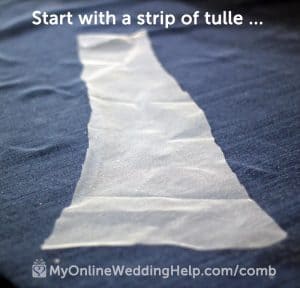
- A piece of veil material (tulle) 4″-6″ wide and about 18″ long
- Needle and thread the same color as your veil
- A plain veil comb (cheap plastic is fine)

How to wrap the comb.
There are other ways to attach your comb, but for me, this seems the most reliable. By securing the comb with thread, you get a harder hold than if you use felt and glue. I also like the way the tulle looks on the front edge of the comb, which might be visible at some points.
- 5.1 Twist the tulle into a strip that will fit between the teeth of the comb.

- 5.2 Begin by giving the twisted tulle a short “tail,” which you will secure as you wrap the teeth. Then wrap the long end of the tulle between the first and second teeth and pull tight.

- 5.3 Continue wrapping through the second and third teeth, trapping the short tail against the base. Repeat this process until you reach the last tooth.

- 5.4 Cut off excess tulle. Glue or tack down the tulle at the end of your comb.

“Marrying” the bridal veil to the comb.
You are now going to attach the comb to your veil where the blusher turns into the veil section.
Before you begin, get familiar with the front/back orientation of your veil. If your veil has trim, find where it ends along each edge. This is also where you created the gathers.
Find the underside of your veil. And turn the veil, so your blusher is toward you, upside down. You should be looking at the backside of any trim or beading.
Position the comb so, when on, the comb will curve toward your head with teeth pointing back. And the comb itself is between the blusher and the veil.
If you do not have a blusher, consider sewing on the comb so the veil will flip back over the comb base. This will hide the raw edges.
- 5.5 Thread about 18″ of thread through the needle and knot it. Then, beginning at one veil edge, pull the needle through both the veil and tulle on the comb’s end. So the comb and trim “kiss.”

- 5.6 After the initial stitch, sew all the way across, catching your thread in the gathers. When you get to the end, tie off and knot the thread. Clip any stray threads. Also, rub out visible pencil marks, and smooth uneven edges so the veil looks polished.

Congratulations, you have made you own wedding veil with a comb! Next see how to attach a veil to a headband or flower crown.

Step 5 Video – Attaching the Comb
If making your veil from start to finish is overwhelming.
There is one question you should ask yourself before deciding to tackle each DIY wedding project. Do you have the time, talent, and tenacity to make it to your liking?
Because a wedding involves so many tasks, your time is precious. A simple, plain veil takes little time to make. But begin adding decorations and the commitment soars.
If–after looking through the steps to making a veil–you decide it is not your cup of tea, no worries. All of the simple wedding veils here cost around $40 or less. After factoring in the time it would take to make your own veil, you may decide to buy at a low price instead of DIY.
If you would like to see my other veil tutorials, then please check out DIY Wedding Veil Tutorials for all of my veil-related tutorials.
FAQ for How to Make a Wedding Veil
How do you cut a veil?
The biggest hurdle in cutting a wedding veil is knowing how long you want the veil to be. Decide this, then measure and cut according to your handmade pattern. See step one for all the details.
How do I make a drop veil?
A drop veil is a veil with no gathers or attached comb. Follow step one of the instructions to cut your tulle and you've made a drop veil! It's so simple.
How do I gather a wedding veil?
Gathers in a wedding veil are simply folds in the material. Scrunch the tulle and weave a piece of thread through it. Watch and read the details in step four of the how to make a wedding veil tutorial.
How do I make a veil with lace trim?
Bridal or other lace trim can be sewn or glued to the raw edge of your veil. See step three in the tutorial for written and video instructions.


Chris
Wednesday 19th of April 2023
Do I need to cut off the selvage edge from the veil before I begin?
Bobette Kyle
Wednesday 19th of April 2023
I haven’t done it that way, but if you want to leave it on for better control of material while you work seems like you could. See what it looks like and consider whether you are going to add trim over it for your final decision.
Angela Haier
Friday 9th of September 2022
I am an experienced seamstress. I'd like to make my daughter's veil. Your site has lots of great info but WOW is it hard to find it. Is their a way to just get the video tutorials for a simple cathedral veil??
Bobette Kyle
Friday 9th of September 2022
Hi, Here’s a cathedral veil tutorial. It is two tiers, one detachable. But you can adjust it by cutting material for only one of the tiers and attach the comb without Velcro.
https://www.myonlineweddinghelp.com/wedding-diy/how-to-make-a-cathedral-veil-lace-trim/
https://youtu.be/qWkZhM92qBI